The Moon: Back to
the Future

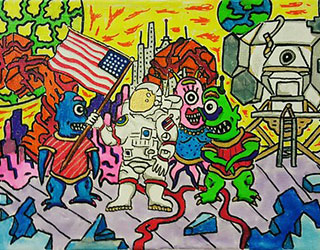
Image of painting called 2054 by Brent Bishop
|
|
To
all prospective contestants:
This
contest remains open and will make awards for the
lunar-centric challenge due on April 15, 2010. In
addition, due to NASA's recent change of focus
from a manned lunar mission to other exploration
priorities, we will also accept Mars themed entries
for the April 15 due date. Next fall, we
expect to change the challenge of the artcontest
to reflect new NASA missions.
View
the 2010 Contest winners
Download the 2009
Digital Exhibit of the Contest Winners
(.mov
version) or (.wmv
version)
View
the 2009 Contest winners
2009
-2010 Contest at a Glance:
The National Aeronautics and
Space Administration invites high school and college
students from all areas of study to enter, including
the arts, industrial design, architecture, computer
design, and the fine arts. Students are asked to
submit their work on the theme: Life and Work on
the Moon. Artists are encouraged to collaborate with science and
engineering students. Such collaboration is not required, but would help
to ensure that the art is valid for the Moon’s
harsh environment. Any full time student can enter,
regardless of major or area of study.
Entries will be accepted in three categories: two-dimensional,
three-dimensional, and digital, including music and
video. For the first time, we will also accept entries
in literature (poetry and short stories). Entries
will be evaluated on creativity, artistic qualities,
but also on whether they depict a valid scenario
for the moon's harsh conditions. Prizes include
awards and exhibit opportunities. Entries are due
no later than April 15, 2010.
Please direct any questions to Dr. Elizabeth Ward
at Elizabeth.B.Ward@nasa.gov
Download the short video animation Back to the Moon
http://sacd.larc.nasa.gov/multimedia/LATtrailer.html
Entries will be accepted in three major categories:
two-dimensional (including Literature), three dimensional,
and digital (including video and music). Each category
will have pre-determined size limits.
- All entries are due no later than April 15,
2010 for College entries and April 15, 2010 for
High School entries.
- Cash prizes, certificates of
achievement, and exhibit opportunities are planned.
- We
expect that winners will be announced in June of
2010.
- All entries will initially be submitted digitally
as 300 dpi jpeg images for traditional art and
other file types for literature, music, and video.
- An on-line gallery is planned for public viewing
of the artwork.
- Winners may be asked to ship their
work to NASA for exhibit purposes.
|
|
CONTEST NEWS
RELEASE: 10-158
NASA ART AND DESIGN CONTESTANTS CREATE MULTI-MEDIA VISIONS OF LUNAR LIFE
WASHINGTON -- NASA has selected the winners in the 2010 Life and Work
on the Moon Art and Design Contest from more than 200 international
student entries.
Participants envisioned an imaginative lunar lifestyle through various
artistic media. Entries were accepted in many categories, including
music, video, two-dimensional, three-dimensional and digital art. For
the first time, poetry and short stories were accepted in a
literature category.
"Offering students the opportunity to express themselves through art
allows us to reach out to people who otherwise might not be able to
participate in our program of exploration," said Jerry Hartman,
education lead for the Exploration Systems Mission Directorate at
NASA Headquarters in Washington. "Plus, the young people come up with
a lot of cool stuff."
Dalton Mills, a student at Central High School in La Crosse, Wis., was
the overall winner for his video and animation entry, "Moonshot." He
was inspired by NASA documentaries, other artists, science and
physics classes.
"Three-D art is a hobby of mine," Mills said. "In the future,
I would
like to pursue engineering and physics and freelance my artwork."
A panel of scientists, professional artists and educators from the
U.S. and other nations judged student submissions. The judges based
their reviews on three elements: the artist's statement -- which
described the student's inspiration; the artistic media they chose
and why -- showing creativity and artistic expression; and the
validity of the created situation based on the moon's harsh
conditions.
Jim Plaxco has judged the contest for three years and runs his own
digital art gallery website called Artsnova. "What I found most
rewarding about the experience was having the opportunity to review
the art, think about its meaning, admire its quality and read the
artist's words about their intent and inspiration," he said.
Mitchell Peterson of Sheridan College in Sheridan, Wyo., won the
college division. He created a graphite and color pencil drawing
accompanied by original music called "Beyond the Atmosphere." He also
included a variety of voice and other sound bites in his music,
including clips from the Apollo lunar missions and from the movie,
"It's a Wonderful Life."
Brennan Barrington, a student at Licking Heights High School in
Pataskala, Ohio, won the high school division. Barrington wrote
a
short story called "Helium 3" that was inspired by Jack London's
story, "To Build a Fire." "It was tricky to get all the details
of
gravity, how the dust moves, and things that like, but I got it
done," Barrington said.
The contest is sponsored by NASA's Exploration Systems Mission
Directorate and is managed by Christopher Newport University, Newport
News, Va. More than 40 entries came from non-U.S. locations including
Bermuda, China, Columbia, Czech Republic, Georgia, India, Italy,
Pakistan, Poland, Slovakia, Thailand, United Kingdom and Venezuela.
The top cash award was $1,000 with smaller prizes for the top finisher
in each category. Top non-U.S. students received an engraved plaque
to acknowledge their achievement. The winning entries will be
displayed digitally in NASA and museum locations across the country.
Details about a new contest will be announced in September.
For gallery viewing of winning entries, visit:
http://artcontest.cet.edu
For information about NASA research and exploration programs, visit:
http://www.nasa.gov
Artist contributions can help
with space exploration
http://www.newsweek.com/id/220438
NASA's New Lunar Electric Rover (LER) to participate
in President's
Inaugural Parade
http://www.nasa.gov/exploration/home/LER.html
|
 |
|
Why is NASA sponsoring this
contest?
Once humans establish a presence on the Moon, the arts
will be a desired facet of life there, as they are
here on Earth. It is our intention to provoke non-science
and engineering students to think about the science
and engineering required to achieve the conditions
suitable for humans to live and work on the moon. It
is also our intention to help the science and engineering
communities appreciate valuable contributions from
other communities, particularly the arts. We
hope to see outstanding student art work that will
inspire this and future generations of explorers.
|
|
 |
|
|
|
|
 |
|